An Engineering Approach to the Historically Underdamped Nature of Flexing Wind
 March 1, 2026 19:41
This blog replaces the one I began writing last summer. Over a series of posts, I conducted a design study that was focused on building a conceptual yet physically credible organ for a Minneapolis church. The study used pipes from their existing mid-industrial-era gallery organ to explore possibilities for a 43-note continuo suited to this space. I creatively drew on my familiarity with both the materials and the space, having served as an organist there for eight years.
Last November, I wrote an entry I was particularly proud of, titled “An Engineering Approach to the Historically Underdamped Nature of Flexing Wind.” Let me repeat some of the entry here.
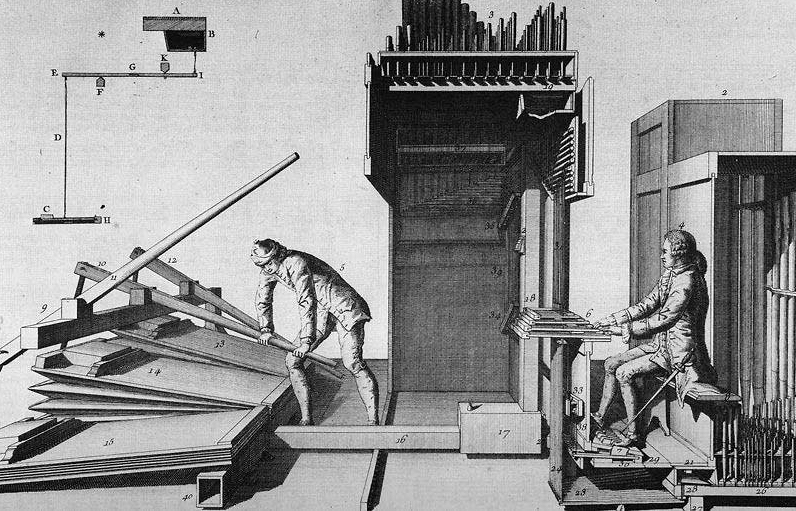
The image above is taken from the treatise "L'art du facteur d'orgues," written in the eighteenth century by the French organ builder Dom Bédos de Celles. It is still widely considered an authoritative work today. The winding system shown contains several wedge-shaped bellows, which are raised by hand and allowed to fall under gravity. Weights placed on each determine the wind pressure.
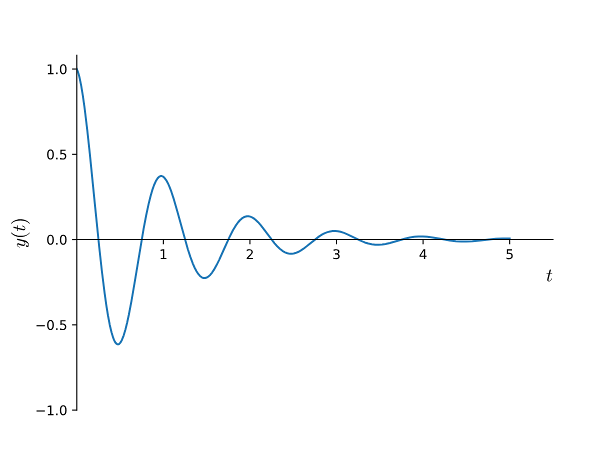
The bellows should fall at a constant rate, depending on the volume of air released from each pipe. But the abrupt opening of the pipe valves as one plays the organ often induces a short pulsation in the bellows if not somehow damped. This vibration dissipates to a steady state rather quickly, but it is noticeable to the ear. In other words, an early wind system is an example of an underdamped dynamic system, one that exhibits a steady-state response along with a short initial transient response.
A course in dynamic systems was part of my mechanical engineering curriculum while I was an undergraduate. I won't get into the math here. I won't develop equations of motion or make you solve them using differential equations and Laplace transforms. But I want to include the graph here, attributed, showing a transient response decaying to a steady state.
In addition to the graph, you can hear the transients in this audio recording I made on the first organ I built as an independent builder. The recording is one verse of the Advent hymn, "O Come, O Come, Emmanuel."
The winding systems for the organs I built for two Lutheran churches that have since closed were not a series of wedge-shaped bellows. I modeled their behavior using a dynamic systems approach, creating an underdamped wind supply with a transient response that decayed to a steady state.
An organ intended to play Romantic or Orchestral-Symphonic music needs steady wind, free of the transients often typical of Baroque instruments, and requires an overdamped wind supply rather than an underdamped one. Steady wind is currently favored among the organ community, and I was ready to build my 43-note continuo with a steady wind supply. But lately, I see no reason to use a go-along-to-get-along approach to something that adds a beautiful dimension to the instrument's sound and the music it plays.
My innovative wind reservoir design, supplied by an electric blower, imitates the wedge bellows. It's compact and easy enough to build. I don't have to think of it as historically aligned either. It's another design element that defines my 43-note continuo.
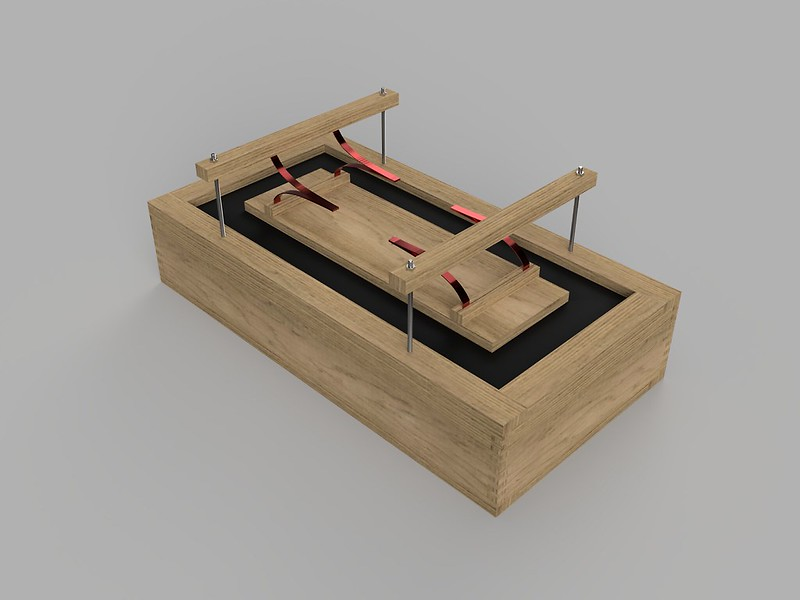
Something happened after I wrote this entry. I no longer wanted to write. The conceptual instrument became real enough to me that I wanted to see and hear it, and I wanted others to see and hear it. I decided the best way to do that was to self-fund and build a 25-note subset. This blog will document its build along with some of the thought processes that go into its design.
Posted March 1, 2026 19:41
Add Your Comment
Already signed up? Login.
 RSS Feed
A Storytelling Approach to Journal Gorham Street Content
by Steve Panizza

Recent Blog Entries
Archive